I reorganized my essay to make a clearer, more logical, and concise reading. I started with the definitions of prescriptivism vs. descriptivism before moving into social examples and dialect biases. I also made the transitions stronger between sections, so each paragraph could flow/transition naturally, making my argument easier to follow.
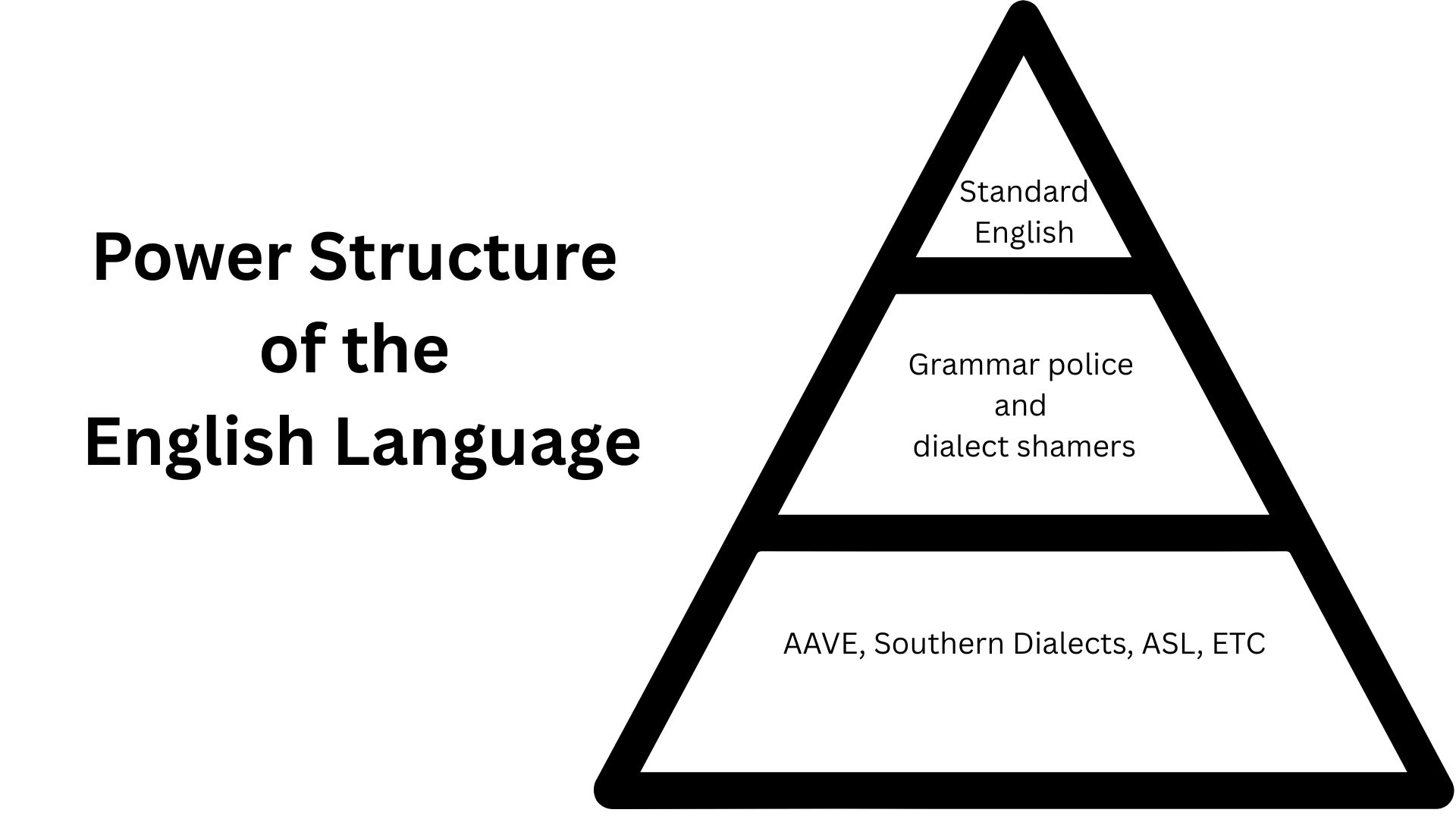
First Draft:
The harms of prescriptivism
Language shouldn’t be divided between ‘correct’ and ‘proper’. The thought that there is only one way to speak a certain language falls into the ideology of prescriptivism. It is the belief that different accents, dialects, or the use of words should not be a thing. The idea of prescriptivism is an attack on multiple cultures and only breeds prejudice and bias in media and literacy.
‘Correcting’ language is present in many different places, whether it occurs in conversations, in letters to newspapers, or nowadays, online through social media. The idea of correcting someone else is present and can be seen actively occurring throughout society, which can shape language norms. Even though these discussions may seem trivial, they shape how literacy is taught and how people are viewed as ‘educated’ or ‘articulate’. Morana Lukač brings up and titles the term ‘grassroots prescriptivism’, which includes people from many different backgrounds, and how they all lead to shaping and trying to standardize language to one specific form. (Grassroots prescriptivism 5). Debates over the topic of prescriptivism often privilege the ‘dominant’ group, whereas it marginalizes different dialects and linguistic styles. Discrediting the variety and different forms of language also discredits the idea of culture and self-respect for one’s roots and origins. The concept of prescriptivism itself is connected and tied to linguistic gatekeeping.
Linguistic gatekeeping has a similar meaning to prescriptivism, the idea that language should and has to fit in one specific form, and any slight form of deviation from the standard is looked down upon by linguistic gatekeepers. The issue with this is that gatekeeping can occur not just in standard English but also in different forms of communication. Such as in the ASL community, a language based around inclusion for the impaired. Linguistic gatekeeping or prescriptivism is present and prevalent in this community, which tends to deter a lot of people from participating or taking an interest in the language itself. Rach uploaded a TikTok under the username “SuchaLovelyRed.” Her video is on how many people have hated/called her out on how her form of speaking ASL doesn’t fall within “True ASL” as she picked up an older form of sign. language from her grandfather (2023). This leads to a bigger divide between people and groups. However, there are many defenders of prescriptivism.
Dallin D. Oaks is one prominent defender of prescriptivism; he argues that many linguists reject the idea of prescriptivism for descriptivism, which he views as being too ideological and unrealistic in practice. Furthermore, it is argued that there should be regulations based on the setting, such as the environment you are in, whether it is a professional or academic setting. Oaks’ paper encourages linguistics to stop treating prescriptivism as a form of ‘taboo’ and instead recognize the value of “measured prescriptivism.” (Linguistic encounters in real-world prescriptivism: Acknowledging its place and role). The idea that there should be a balanced approach that accepts rules when they serve real-world communication and learning.
The negative aspects of prescriptivism are still felt throughout cultures and groups of people. One specific example is the disassociation between standard ‘English’ and black ‘English’. Even though they are both the same language, one is seen as improper, especially in professional settings, while the other is normalized and seen as the only one that should be used. There are many different slang terms and words that are present in Black English but not in Standard English. Some examples being “Finna”, “Aint”, and “Goat”. Even though these terms aren’t usually seen in regular English, they hold a ton of value and importance in black culture.
Nate Marshall wrote a poem on the word “Finna”, it means “fixing to”, and throughout the text, Nate talks about the importance of it, as at first he started off feeling self-conscious on using the word in an academic setting, he felt as though the word didn’t belong, but throughout his poem he shows how he found his love for the word, as it led to him finding a place of solace in his time of need. “Finna” made him find comfort in his culture and origins. (FINNA 28). I believe that the idea of different language styles being forbidden or looked down upon is extremely harmful for many different communities. Using Nate’s experience as an example, when someone is raised with their culture in mind, they learn to love themselves and love their culture more prominently, but when that cultural aspect of language is stripped away in an academic sense, a part of them is stripped away with it.
Many people believe that different dialects or forms of English are illogical or have no proper backing for the meaning behind them. African English and Southern English are two primary examples of being looked at as improper, as they differ from the norm. A lot of these biases against different types of English often stem from racism, classism, and stereotypes throughout the years. Southern English is often tied to ‘uneducated rural’ people, while African English is viewed as inferior through its association with Black people, as they were seen as inferior, a stigma rooted in racism and slavery.
John Fought’s discussion of language gatekeeping ties into the previous idea of how prescriptivism and linguistic gatekeeping occur socially everywhere, and it is seen as acceptable within society, but it neglects the deeper prejudices behind it. Features which are commonly associated with African American English or Southern dialects, such as double negatives, are not linguistically illogical at all. They only appear “wrong” because powerful groups have decided which forms of English count as legitimate (Fought, John. Barring the Gates of Language. In Do You Speak American? 2005). Fought illustrates an important issue, which is that language criticism repeatedly masks social bias, allowing people to discriminate based on race or class without openly saying it. Fought and Lukač both have the same mindset against the idea of prescriptivism, both of whom bring up the negative aspects of prescriptivism. The contradiction between prescriptivism is descriptivism.
Descriptivism and prescriptivism represent two opposing ways of understanding language as a whole, not just the English language. Descriptivism focuses on understanding how people actually speak and write, treating all dialects and different speech patterns as valid forms of communication with their own internal rules. In contrast to that, prescriptivism is worried with how people should speak, and enforces a fixed standard. Which often only reflects the preferences of socially powerful groups. Descriptivism helps recognize multiple dialects and helps to fight against the idea of gatekeeping, an issue that is prevalent in multiple groups.
Elqayam and Evan also help with the critique of prescriptivism by showing how the same issue appears not only in language but also in the study of human reasoning. They state that psychologists often make the mistake of judging human thinking against idealized standards, a mistake referred to as “normativism,” the belief that there is a single correct way people ought to think. (Elqayam, Shira, and Evans, Jonathan. Subtracting “ought” from “is”: Descriptivism versus normativism in the study of human thinking. 234). A good example of this is that before the discovery of the Earth’s shape, many scientists at the time believed that the Earth was flat, and any idea against the norm was looked down upon or viewed as idiotic; however, through research and breaking that ‘norm’, people were able to have a better understanding of science and the universe itself.
Elqayam and Evans both advocate for descriptivism, which focuses on describing real human thinking without having any form of moral judgment against it. Similar to how descriptivist linguists study language without worrying about and enforcing “proper” rules of language. When researchers mix what people do with what experts think they should do, it creates a form of confusion and bias. So removing the ‘norm’, or what people “should” do, would help get rid of the bias and also create respect for how people naturally think, speak, and talk.
It can be seen that across linguistics, culture, and even human psychology, the idea of a single “correct” way of speaking does more harm than good. Prescriptivism suggests it is to protect clarity and help create a standard for people to try and aim for, but in practice, it just reinforces multiple social hierarchies and stereotypes by only putting the language of dominant and non-marginalized groups in the spotlight. From Lukač’s grassroots prescriptivism to John Fought’s ideology on linguistic gatekeeping, it is obvious how judgments and biases about different dialects like African English or Southern English show the deep-rooted prejudice tied to race and class. Elqayam and Evans show that the idea of prescriptivism transcends language and shows up in similar patterns within human reasoning known as normativism. These authors show that variation within languages or thinking ability shouldn’t be a flaw, but a reflection of one’s identity, culture, and human diversity. By embracing diversity rather than gatekeeping it, we can create multiple spaces for educational and professional reasons that respect people for who they are, not for how closely they can match the “standard”. Getting rid of prescriptivism is not only about grammar, but also about belonging, and allowing people to be valued for who they are.
Final Draft:
The harms of prescriptivism
Language shouldn’t be divided between ‘correct’ and ‘proper’. The thought that there is only one way to speak a certain language falls into prescriptivism, the belief that one language variety is superior and should be promoted with rules for “correct” usage. It assumes that different accents, dialects, or the use of words should not be a thing. Language prescriptivism is an attack on non-standard English and thus breeds prejudice and bias in the media and literacy. To better understand why this mindset is harmful, it helps to contrast prescriptivism with its opposition.
Descriptivism and prescriptivism represent two differing ways of understanding language as a whole, not just the English language. Descriptivism focuses on understanding how people actually speak and write, treating all dialects and different speech patterns as valid forms of communication with their own internal rules. In contrast to that, prescriptivism is worried with how people should speak, and enforces a fixed standard. Which often only reflects the preferences of socially powerful groups. Descriptivism helps recognize multiple dialects and helps to fight against the idea of gatekeeping, an issue that is prevalent in multiple groups. Prescriptivism occurs naturally and can be seen in everyday society.
‘Correcting’ language is present everywhere, whether it occurs in conversations, in letters to newspapers, or nowadays, online through social media. The idea of correcting someone else is present and can be seen actively occurring throughout society, which can shape language norms. Even though these discussions may seem trivial, they shape how literacy is taught and how people are viewed as ‘educated’ or ‘articulate’. Morana Lukač brings up and titles the term ‘grassroots prescriptivism’, which includes people from many different backgrounds, and how they all lead to shaping and trying to standardize language to one specific form. (Grassroots prescriptivism 5). Debates over the topic of prescriptivism often privilege the ‘dominant’ group, whereas it marginalizes different dialects and linguistic styles. Discrediting the variety and different forms of language also discredits the idea of culture and self-respect for one’s roots and origins. The concept of prescriptivism itself is connected and tied to linguistic gatekeeping.
John Fought’s discussion of language gatekeeping ties into the previous idea of how prescriptivism and linguistic gatekeeping occur socially everywhere, and it is seen as acceptable within society, but it neglects the deeper prejudices behind it. Features which are commonly associated with African American English or Southern dialects, such as double negatives, are not linguistically illogical at all. They only appear “wrong” because powerful groups have decided which forms of English count as legitimate (Fought, John. Barring the Gates of Language. In Do You Speak American? 2005). Fought illustrates an important issue, which is that language criticism repeatedly masks social bias, allowing people to discriminate based on race or class without openly saying it. Fought and Lukač both have the same mindset against the idea of prescriptivism, both of whom bring up the negative aspects of prescriptivism. They also help us understand how gatekeeping can produce harmful stereotypes toward certain dialects or anything that doesn’t fit within standard English.
Many people believe that different dialects or forms of English are illogical or have no proper backing for the meaning behind them. African English and Southern English are two primary examples that are often viewed as improper, as they differ from the standard. A lot of these biases against different types of English often stem from racism, classism, and stereotypes throughout the years. Southern English is often tied to ‘uneducated rural’ people, while African English is viewed as inferior through its association with Black people, as they were seen as inferior, a stigma rooted in racism and slavery.
The divide between Standard English and Black English shows these biases even more clearly. Although they are both the same language, one is seen as improper, especially in professional settings, while the other is normalized and seen as the only one that should be used. There are many different slang terms and words that are present in Black English but not in Standard English. Some examples being “Finna”, “Aint”, and “Goat”. Even though these terms aren’t usually accepted in standardized English, they hold a ton of value and importance in black culture.
Nate Marshall wrote a poem on the word “Finna”, it means “fixing to”, and throughout the text, Nate talks about the importance of it, as at first he started off feeling self-conscious on using the word in an academic setting, he felt as though the word didn’t belong, but throughout his poem he shows how he found his love for the word, as it led to him finding a place of solace in his time of need. “Finna” made him find comfort in his culture and origins. (FINNA 28). I believe that the idea of different language styles being forbidden or looked down upon is extremely harmful for many different communities. Using Nate’s experience as an example, when someone is raised with their culture in mind, they learn to love themselves and love their culture more prominently, but when that cultural aspect of language is stripped away in an academic sense, a part of them is stripped away with it. Another community affected by gatekeeping is the ASL community, which faces similar issues of having to be “correct.”
The issue is that gatekeeping can occur not just in standard English but also in different forms of communication. Such as in the ASL community, a language based around inclusion for the impaired. Linguistic gatekeeping or prescriptivism is present and prevalent in this community, which tends to deter a lot of people from participating or taking an interest in the language itself. Rach uploaded a TikTok under the username “SuchaLovelyRed.” Her video is on how many people have hated/called her out on how her form of speaking ASL doesn’t fall within “True ASL” as she picked up an older form of sign. language from her grandfather (2023). This leads to a bigger divide between people and groups. However, there are many defenders of prescriptivism. One of the strongest defenders is linguist Dallin Oaks with a different perspective on the matter.
Dallin D. Oaks is one prominent defender of prescriptivism; he argues that many linguists reject the idea of prescriptivism for descriptivism, which he views as being too ideological and unrealistic in practice. Furthermore, it is argued that there should be regulations based on the setting, such as the environment you are in, whether it is a professional or academic setting. Oaks’ paper encourages linguistics to stop treating prescriptivism as a form of ‘taboo’ and instead recognize the value of “measured prescriptivism” (Linguistic encounters in real-world prescriptivism: Acknowledging its place and role). The idea that there should be a balanced approach that accepts rules when they serve real-world communication and learning. His argument becomes more complicated when we see the effects of prescriptivism outside of language.
Elqayam and Evan also help with the critique of prescriptivism by showing how the same issue appears not only in language but also in the study of human reasoning. They state that psychologists often make the mistake of judging human thinking against idealized standards, a mistake referred to as “normativism,” the belief that there is a single correct way people ought to think. (Elqayam, Shira, and Evans, Jonathan. Subtracting “ought” from “is”: Descriptivism versus normativism in the study of human thinking. 234). A good example of this is that before the discovery of the Earth’s shape, many scientists at the time believed that the Earth was flat, and any idea against the norm was looked down upon or viewed as idiotic; however, through research and breaking that ‘norm’, people were able to have a better understanding of science and the universe itself.
Elqayam and Evans both advocate for descriptivism, which focuses on describing real human thinking without having any form of moral judgment against it. Similar to how descriptivist linguists study language without worrying about and enforcing “proper” rules of language. When researchers mix what people do with what experts think they should do, it creates a form of confusion and bias. So removing the ‘norm’, or what people “should” do, would help get rid of the bias and also create respect for how people naturally think, speak, and talk.
It can be seen that across linguistics, culture, and even human psychology, the idea of a single “correct” way of speaking does more harm than good. Prescriptivism suggests it is to protect clarity and help create a standard for people to try and aim for, but in practice, it just reinforces multiple social hierarchies and stereotypes by only putting the language of dominant and non-marginalized groups in the spotlight. From Lukač’s grassroots prescriptivism to John Fought’s ideology on linguistic gatekeeping, it is obvious how judgments and biases about different dialects like African English or Southern English show the deep-rooted prejudice tied to race and class. Elqayam and Evans show that the idea of prescriptivism transcends language and shows up in similar patterns within human reasoning known as normativism. These authors show that variation within languages or thinking ability shouldn’t be a flaw, but a reflection of one’s identity, culture, and human diversity. By embracing diversity rather than gatekeeping it, we can create multiple spaces for educational and professional reasons that respect people for who they are, not for how closely they can match the “standard”. Getting rid of prescriptivism is not only about grammar, but also about belonging, and allowing people to be valued for who they are.

